Is Spin the Wheel Rigged? How the Randomness Works
Worried a spin wheel can be fixed? How the randomness really works, why repeat winners are normal, and how to run a spin nobody can argue with.
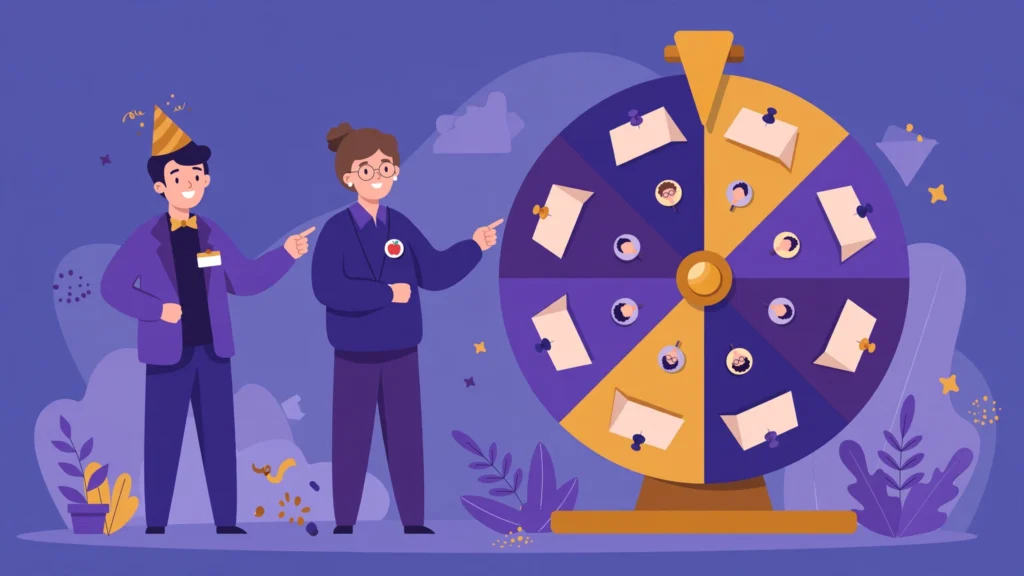
Type a list of names into a wheel, press spin, and let chance pick one. That simple idea is what people mean by a wheel of names random name picker. The phrase has become the everyday name for a whole family of online tools. Picture a colourful wheel divided into slices, one name on each slice, with a pointer fixed at the top. The wheel turns, slows down, and stops. The name sitting under the pointer is the pick. Nobody has to draw folded slips of paper from a hat, nobody points at a list with their eyes closed, and nobody can argue about the result, because the whole group watched it happen.
Using one takes less than a minute. You type or paste your names into a list, one name per line. The wheel builds itself as you type, and every name gets a slice of exactly the same size. When you press spin, the tool picks a random starting point and a random spin strength, then lets the wheel turn and slow in a natural way until the pointer settles on one slice. Nothing about the result is decided in advance. The winner is simply wherever the wheel happens to stop.
A good wheel of names spinner adds a few thoughtful touches around that basic spin. You can shuffle the list so the order feels fresh, remove the winner after each spin so nobody gets picked twice, and see the result announced clearly. Some wheels let you give an entry extra weight by adding it more than once, which suits raffles where one person has earned extra entries. The core idea never changes though. Equal slices, a random spin, and a result everyone can see.
Teachers were among the first to adopt name wheels, and it is easy to see why. Reading order, who answers next, who presents first, who leads the line. A wheel answers all of it without playing favourites, and students accept a result from a spinning wheel far more readily than the same result from a teacher’s pointed finger. The short wait while the wheel slows even settles the room, because everyone is watching the same thing.
For hosts, a wheel of names randomizer turns a private draw into a public one. Paste in the entrants, share your screen or record the spin, and the winner is chosen in front of the audience. That visibility is what makes people trust the outcome. It works for a small raffle at a school fair just as well as it works for a giveaway with a few thousand comments underneath a post.
Beyond classrooms and prizes, name wheels settle the small stuff. Picking team captains, drawing names for a gift exchange, deciding who presents first in a meeting, splitting a group into pairs. Anywhere a list of people needs one fair answer, people reach for a wheel of names instead of arguing about it.
If the names for this tool confuse you, you are not alone. People search for a wheel of names spinner, a wheel of names randomizer and a wheel of names generator, and they are all describing the same thing. A spinner emphasises the turning wheel. A randomizer emphasises the chance behind the pick. A generator emphasises building the wheel from your list. Different words, one tool. Whatever you call it, judge it by the same things. Equal slices for every name, a spin you can watch, and a winner chosen where everyone can see.
Fairness in a name wheel comes from a short list of properties. Every entry gets an equal slice, so every entry has an equal chance on each spin. The spin itself is random in strength and duration, so the stopping point cannot be aimed at a name. The full list is visible before the spin, so nobody can quietly add or remove names at the last moment. And when winners are removed after each spin, a long session works through the whole list instead of landing on the same person again and again. A wheel that does those four things is doing its job properly. Choosing by lot is an old idea with a name of its own, sortition, and it has been trusted to keep selections fair for centuries.
If you are looking for a wheel of names alternative that simply works, the wheel on this site was built for exactly these jobs. It is free, it needs no sign up, and you can be spinning within seconds of opening the page. Add your names on the homepage wheel for a quick pick, or use the name generator when your list is the whole point. Your list stays in your own browser and is never uploaded anywhere, which matters when the names belong to your class, your team or your customers. The wheel also speaks fourteen languages, so the same tool works for groups who would rather spin in their own language.
Yes, when it is built properly. Each spin starts from a random point with a random strength, and every name holds an equal slice of the wheel. No name is favoured, and past results have no effect on the next spin.
Far more than most people need. Classroom lists, raffle entries and team rosters all fit comfortably. Very long lists still work, although the slice labels get small, so big draws are often easier to follow when you spin in rounds.
Not on this site. There is no sign up and nothing to install. Open the page, add your names and spin. Your list lives in your browser, so it is still there if you come back later on the same device.
A wheel suits informal raffles, classroom draws and community giveaways well. For draws that are regulated or carry large prizes, check your local rules first. Some of them require certified drawing methods, and a browser wheel may not qualify.
Put the names or options in, give it a spin, and let the wheel settle it fairly, in front of everyone.
Spin the wheelWorried a spin wheel can be fixed? How the randomness really works, why repeat winners are normal, and how to run a spin nobody can argue with.
Stuck between two good options? A decision making wheel ends the back and forth in one spin. When it helps, when to skip it, and how to keep group picks fair.
How to pick a giveaway winner fairly with a free winner picker, with steps for Instagram and TikTok draws and a fairness checklist anyone can audit.